Historik · 2021–2025
The Discipline of Calling It
Founding, Running, and Winding Down a Venture-Backed Startup — and What Four Years of Carrying Every Hat Taught Me About Leadership
Founder, Historik · 2021–2025
Concurrent with Angel from August 2022 forward
Executive Summary
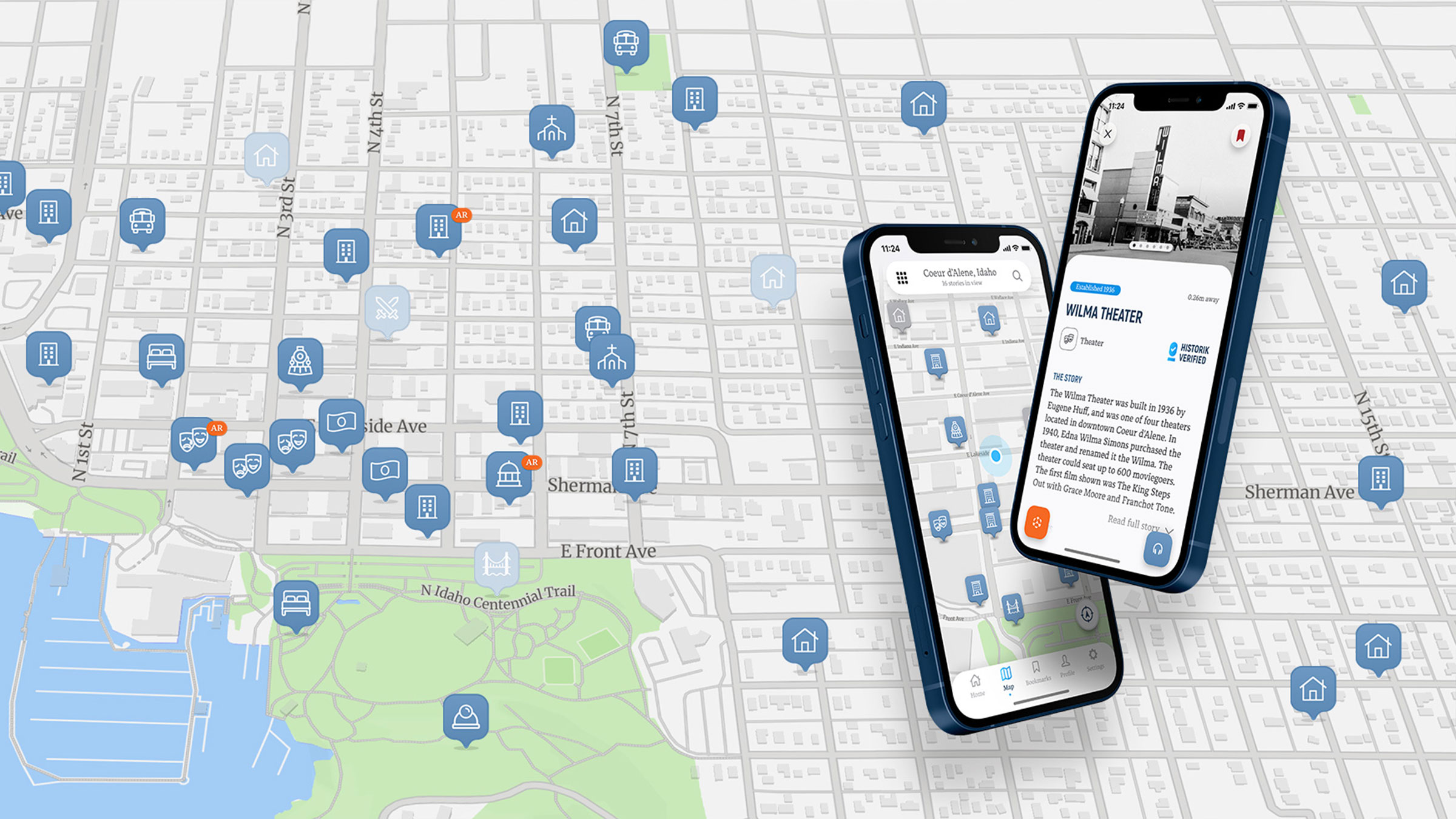
In 2021, I quit my job of four years helping build someone else's startup and committed full-time to building my own — Historik. The product was a mobile app that placed people back in history where it occurred — turning roadside signs, weathered plaques, and forgotten places into stories you could actually engage with. A two-sided platform. A content management system for museums and historical institutions on one side. A consumer mobile app on the other.
I raised $150,000 in seed capital, filed a patent on the platform, recruited a CTO, built the MVP across web and iOS, hired and led a team of engineers, secured a first paying customer, onboarded ten more institutions onto the platform, and ran the company for four years. In 2025, I made the call to wind it down and transfer the IP to the Museum of North Idaho — a nonprofit I had partnered with from the beginning, so the work could continue to serve the local community it was founded from.
This is the case where I learned how to build something from zero. It's also the case where I learned that leadership is knowing when to keep going — and knowing when to stop.
Business Challenge
The idea had been with me for over a decade before I committed to building it. A problem I kept circling back to because it bothered me every time I encountered it.
In the summer of 2011, I was on a road trip with my wife through southern Idaho, passing scenic history signs at 60 miles an hour. I would crane my neck trying to read them. I couldn't. I'd visit places that had real stories underneath them and find weathered signs, missing plaques, or nothing at all. The history was there. The interaction with it was broken.
That observation became Historik. A mobile experience that geo-located historical stories so anyone standing anywhere could engage with what had happened on that ground — without having to stop, without having to squint, without having to know the history was there to begin with.
The market was two-sided. Museums and historical institutions would license a content management system to digitize and publish their collections. Consumers would discover those stories through the mobile app, free at the point of use. Institutional licenses were the revenue engine. The consumer app was the distribution.
The bet was that history was being lost at the speed of weather and time, and that a digital layer could preserve it before it disappeared.
Organizational Challenge
In 2021, the entire company was me. By the end of that year, it wasn't.
I closed an initial six-month bridge from an early investor, then secured a $150,000 seed in December 2021. The seed was R&D capital — designed to last six months and get us to a follow-on round that would fund the next phase: further development and a real marketing push to drive institutional adoption.
The first hire was my CTO, Jake Jones, who took an equity stake in the vision. We brought on a full-time backend engineer to build the CMS alongside us, then a second software engineer in early 2022. I hired a frontend and a backend mobile engineer to build the iOS app, and added two contract engineers to accelerate the CMS and backend as the proof of concept moved forward.
At peak, the team was seven people across full-time and contract.
Around that core team, I built an advisory board that punched well above what a $150K seed usually attracts. A former Head of Creative and Franchise Development at Riot Games. The CEO of an AR/VR gaming company who also taught Technology Entrepreneurship at USC Marshall. A venture investor with seventy-five-plus portfolio companies over twenty years. An early investor in Rumble. A PBS Antiques Roadshow appraiser with deep expertise in history and antiquities. Recruiting that group to a pre-revenue seed-stage company was itself a leadership exercise — making the vision real enough that people with established careers wanted in.
I ran every function around that team. I was the founder, the CEO, the product designer for the entire CMS and mobile app, the product manager keeping projects on time through Jira, the head of sales visiting museums across the United States, the head of finance building cap tables and financial models, the fundraiser drafting SAFE agreements with legal counsel, the pitch lead refining the deck and showing up at pitch events to keep it sharp, the investor relations function, the grant writer, and the social media presence for the brand.
Carrying every hat for a season is what running a company actually is. Doing it for four years is what teaches you what every partner on a product team is actually carrying — and how to lead them when you become the leader of that team.
Leadership Role
I was the founder and the chief executive. Every call ran through me, but I relied on the expertise of my team to bring new ideas that made the experience even better.
The work I'm proudest of from that period isn't the product. It's the team I built around it and the way they performed. Jake was the most important hire I ever made. He was an equity partner from day one, not a hire, and he brought ideas and innovations to Historik that I never would have arrived at alone. He saw technical solutions where I saw problems. He shaped the architecture, the API design, the way the platform actually held together under the hood. Historik exists, in the form it existed, because Jake co-built it with me. The mobile engineers I brought on to build the iOS app worked with me directly, day in and day out, on what shipped to consumers. When the contract frontend mobile engineer later volunteered his own time to finalize the MVP after the team had wound down, that wasn't a transactional move. It was a signal about the culture we'd built while we still had funding.
That's the leadership pattern I now run at Angel without thinking about it. Hire people whose judgment you trust. Give them the work. Stay close enough to clear blockers and far enough away to let them lead. The pattern was forged in a company where I couldn't afford to micromanage anyone, because I had eleven other hats on at the same time.
Strategy
The thesis was that institutions would license the platform, and the consumer app would drive discovery.
I filed a patent on the platform in August 2021, covering dozens of concepts around how location-based history could work on a mobile device. In February 2022, Google accepted Historik into the Google Cloud Startup Program — ten thousand dollars per month in development credit. The validation mattered. So did the runway extension.
I went directly to the customer. The Museum of North Idaho was the first to open their doors — and Britt Thurman, the museum's Director, became Historik's first ambassador. I hired a local historian to craft historical stories specifically for the platform each month, working out of the museum. I spent several days a week as a volunteer there myself, scanning archival photos into digital form that became the visual foundation of every story. By August 2022, between the historian and me, we had over 100 stories built for the Coeur d'Alene region. That was the proving ground.
The first paying customer came in December 2022. Anacortes Museum in Anacortes, Washington signed a $1,200 annual subscription. Over the year that followed, they created nearly 40 historical stories for their community using the platform.
That sale gave the team a real jolt of excitement. After a year of building, pitching, and stretching every dollar, someone had paid us for what we'd made. We celebrated it. It felt like the beginning of something. It was also, in hindsight, a window into the wall I was about to hit.
Cross-Functional Alignment
The $150,000 seed was meant to fund six months of R&D and get us to a follow-on round. Four months in, when I started pushing for the next round, the investment landscape had changed. Investors had pulled back on early-stage startups without revenue. The market we'd planned to raise into in mid-2022 was not the market we found.
By June 2022, the call was clear. To preserve what was left of the runway, I had to lay off the engineering team and shift the company from development to preservation. I also had to find a job. Preserving costs meant preserving my own salary too. That is how I came to Angel.
I joined as a Senior Product Designer in August 2022. Angel knew Historik existed before I started. Working on it on nights and weekends was part of the agreement, and it never compromised what I delivered during the day.
The mobile app launched in October 2022. Over the next six months — with zero marketing spend — it drove 3,000 impressions, 950 downloads, and a 49% conversion rate on the App Store listing. Users who installed it came back, averaging 3.16 sessions per active device. The consumer side of the product was working. People who found it wanted to use it.
Historik was in preservation mode by then. My job was to extend the runway as far as it would go, in hopes we'd have more time to acquire paying customers or surface a new investor. What was left of the team was me, Jake, and occasional support from the first backend engineer I had hired. The contract frontend mobile engineer volunteered his time over the summer to finalize the MVP mobile app, in hopes we could turn things around. We were maintaining, not building. Waiting for the next institutional customer or the next investor conversation that might unlock the marketing push we needed to break through.
Investors knew. I kept them informed regularly, and the conversation always came back to the same thing: help me find the path to the next round. I kept showing up to every meeting that might lead somewhere. Two months at Angel turned into a CEO and CXO tap to take on PM and Senior Product Designer for Web. Late 2022, I built the first version of Photon, Angel's design system. January 2023, I joined the TV team. July 2023, my CXO pulled me alongside him as Lead Product Designer. Through every one of those steps, Historik was alive — quieter than before, but alive.
Holding both was hard. I did it because I was passionate about Historik and the problem it had a chance to solve in the world. I wasn't ready to let it go. And holding both turned out to be the most honest training ground I could have asked for. Every leadership pattern I now run at Angel was being stress-tested in real time by a company I owned.
Decision-Making
The reason Historik didn't make it is the reason most startups don't. Product-market fit. But the precise version of that failure is worth naming, because the lesson is more useful than the headline.
We found product-market fit on the consumer side. The mobile app had a 49% conversion rate with no marketing. Users came back. Eleven institutions across eight cities were onboarded to the platform, building stories for their communities. The product worked.
What we didn't find was institutional product-market fit on the revenue side.
What Anacortes Museum taught me — and what every museum conversation that came after confirmed — was that institutional buyers in the history preservation space were a structurally hard sell. Most historical institutions have limited budgets. Many have an older volunteer base that isn't fluent in digital tools. The default posture is to archive physically, not to publish digitally. The buyers we needed to scale onto the platform were the buyers least equipped, by capital and by culture, to make that bet on a new vendor.
A product can work and a business can still fail. The mistake I would have made if I were honest is letting consumer signal convince me the institutional buyer would come around if we just pushed harder. The signal on one side does not promise the signal on the other.
Concurrent with the institutional wall, the venture environment shifted underneath us. The seed market in late 2021 was funding early-stage bets on vision. By mid-2022, every conversation with VCs was about revenue. We had a product, an MVP, and a single paying customer at $1,200. That wasn't the revenue story those rooms wanted to hear, and the institutions we needed to convert into that revenue story were struggling to find capital themselves.
Two correlated forces. The buyer ran out of money. The funder ran out of patience. We were in the middle, watching the path to scale compress from both sides.
I tried every alternative. Grant applications. Partnership conversations. Small pivots to generate revenue. Spread a six-month runway across two years by cutting everything that could be cut and showing up to every conversation that might surface capital.
By late 2024, the truth was on the table. Without additional funding, Historik couldn't continue. I scheduled the meeting with my investors and named it.
Outcomes
I had thought shutting it down was the only option. Then a different path emerged.
The Museum of North Idaho had been Historik's first ambassador. Britt Thurman knew the product better than almost anyone outside the company. When I asked whether the museum would be interested in taking the company on as a nonprofit asset — a way to preserve everything Historik had built and give it a home aligned with its mission — she brought it to her board. The board agreed. In March 2025, the legal transfer closed and all of Historik's assets moved into the Museum of North Idaho's possession.
The day I was signing those papers, Fox News in New York reached out. They wanted to meet about using Historik to share historical stories across the country for America's 250th anniversary. The ink on the transfer wasn't dry yet. I took the meeting alongside Britt — the museum was now the owner. The fit wasn't right. Historik was still MVP, the team was gone, and the timeline Fox News needed wasn't a timeline Historik could meet. Fox passed.
The timing was the hard part. If we had secured funding a year or more earlier, that conversation could have been the accelerant Historik needed. Instead, it arrived the day the company changed hands. A reminder that opportunity and readiness don't always show up together — and that the discipline of leadership includes being honest about which one you have.
I also tried to make the donation count for the investors as a charitable contribution. The valuation cost to qualify the transfer for tax purposes was prohibitive. The investors took the loss. That part didn't work out the way I hoped — but the attempt was the right one. After the company was gone, I was still working on their behalf.
→ Raised $150,000 in seed capital, filed a patent, and earned acceptance into the Google Cloud Startup Program ($10K/month in development credit)
→ Recruited a CTO and built a team of seven across full-time and contract, plus an advisory board with senior leaders from Riot Games, the AR/VR gaming industry, and venture capital
→ Built a two-sided platform — institutional CMS and consumer iOS app — through MVP
→ Onboarded eleven institutions across eight cities, with Anacortes Museum as the first paying customer
→ Built the content engine with the Museum of North Idaho, producing over 100 historical stories for the Coeur d'Alene region
→ Mobile app drove a 49% App Store conversion rate with zero marketing spend over its first six months
→ Stretched a six-month runway into two years through disciplined cost management
→ Transferred Historik's IP and assets to the Museum of North Idaho as a nonprofit-aligned wind-down, preserving the work in service of the mission it was built for
→ Continued rising at Angel through the entire arc — from Senior Product Designer to PM + Sr. PD of Web to Lead Product Designer
Lessons Learned
Two things I carry forward from Historik. The first is what carrying every hat teaches you. The second is the discipline of calling it.
The hats first. I have done every job on a product team. I have been the product manager keeping projects on time when the budget couldn't stretch for one. I have been the head of sales sitting across from a museum director with a budget that won't stretch. I have been the founder writing the financial model at midnight, then the designer reviewing the Figma file at six in the morning. I have been the person in the room who has to make the call no one else can make. That experience doesn't make me a better designer. It makes me a leader who understands what every partner I now work with is actually carrying. A Head of Product who's holding a roadmap and a board update at the same time. An engineer who's trying to ship a feature while three other systems break around them. A CXO who has to make a call without all the information. I've sat in each of those chairs. I lead from that knowledge now.
The second is harder, and it's the one I want recruiters to take with them.
Startups are hard. Defeat is painful. Losing something you spent four years on, that you quit a job for, that you raised capital against, that you built a team around — losing that is a specific kind of weight. I did everything I could to keep Historik alive. I stretched every dollar. I took every meeting. I made every cut I could make. I honored my investors' request to keep going for two years past the point where most founders would have stopped.
And then I called it.
Leadership is knowing when to keep going. It's also knowing when to stop. The discipline isn't in the building. It's in being honest about what the data is telling you, what the market is telling you, and what your investors deserve to hear from you. The discipline is in finding the resolution that does the most good for the most people — for the investors who backed you, for the team who built it with you, for the audience the product was meant to serve — even when that resolution isn't the one you set out to deliver.
I didn't fail at Historik. I built something real, ran it as far as it would go, and made the call when the call needed to be made. The work continues at the Museum of North Idaho, in service of a mission that aligns with what Historik was built for from the beginning.
That's the leader I want to be on every team I lead from here.